
LED lights Abu Dhabi are setting the new standard for modern, energy-efficient illumination across the emirate from government infrastructure to private commercial developments. As the UAE’s Vision 2031 pushes energy efficiency to the forefront, businesses, contractors, and homeowners are switching to LED at an unprecedented pace. The reasons are straightforward: lower electricity bills, longer lifespans, reduced maintenance, and a smaller carbon footprint. Whether you are upgrading a warehouse, a commercial tower, or a residential complex, this guide covers everything you need to make the right investment decision in the UAE market.
What Is LED Lighting and How Does It Work?
Defining LED Technology
LED stands for Light Emitting Diode, a semiconductor device that produces light when electricity passes through it. Unlike traditional bulbs that waste energy as heat, LEDs convert electricity directly into visible light through electroluminescence, making them highly efficient. This efficiency makes solar LED lights in Dubai and the UAE an ideal solution for off-grid outdoor projects, where reliable illumination and low energy consumption are essential.
LED vs. Traditional Lighting: A Direct Comparison
| Feature | LED | Incandescent | Fluorescent |
| Energy Consumption | Very Low | Very High | Medium |
| Lifespan | 25,000–50,000 hrs | ~1,000 hrs | 8,000–10,000 hrs |
| Heat Output | Minimal | Very High | Medium |
| Contains Mercury | No | No | Yes |
| Dimmable | Yes | Yes | Limited |
| Upfront Cost | Medium–High | Low | Low–Medium |
| Long-Term Cost | Very Low | Very High | Medium |
A standard 10-watt LED produces the same brightness as a 60-watt incandescent bulb representing an 83% reduction in energy use for the same light output.
Core Components of a Professional LED System
A complete LED lighting system consists of several integrated components working together:
- LED Chip: The core light-emitting element, determining brightness and color accuracy
- Driver: Regulates the electrical current supplied to the chip, ensuring stable performance
- Heat Sink: Dissipates thermal energy away from the chip to maintain efficiency and lifespan
- Optics: Lenses and reflectors that shape and direct the light beam
- Housing: The fixture body that provides structural support and additional thermal management
The quality of each component directly determines the performance, longevity, and reliability of the entire system. This is particularly important when sourcing LED lights Abu Dhabi suppliers, as product quality varies significantly across the UAE market.
The Benefits of LED Lighting in Abu Dhabi’s Environment
1. Energy Savings in an Extreme Climate
Abu Dhabi’s heat regularly exceeds 45°C, making LED deployments uniquely cost-effective by reducing both direct energy consumption and HVAC heat load simultaneously. Commercial buildings across the UAE that have fully upgraded to LED report energy reductions of 40% to 60%.
2. Durability Under Extreme Conditions
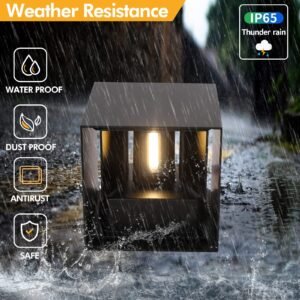
LED fixtures contain no fragile glass or filaments, making them far more resilient than fluorescent or incandescent alternatives. For outdoor applications such as roads, parks, and ports, fixtures rated IP65 or higher provide full protection against dust and water year-round.
3. Alignment with UAE Sustainability Goals
The UAE’s Net Zero 2050 Initiative places energy-efficient infrastructure at its core. Businesses investing in LED lights Abu Dhabi projects are cutting operating costs while directly contributing to a national sustainability agenda that shapes government procurement and green building certifications.
4. Reduced Maintenance Costs
Where traditional bulbs last 1,000 hours and fluorescent tubes reach 10,000, a quality LED fixture routinely achieves 50,000 hours — over 11 years at 12 hours daily. For warehouses, airports, and large retail centers across the UAE, this dramatically reduces labor, downtime, and replacement costs.
Types of LED Lighting Used Across the UAE
1. Commercial and Office LED Lighting
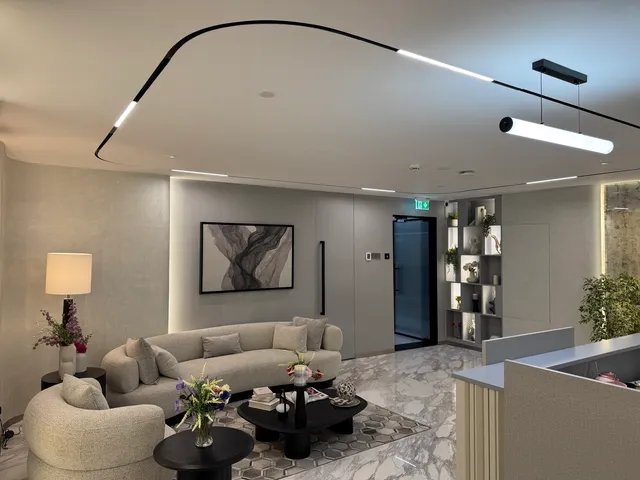
Modern offices in Dubai and Abu Dhabi rely on LED panel lights, linear fixtures, and recessed downlights to improve productivity and visual comfort. Most systems use a CRI of 80+ and a color temperature between 4000K and 5000K. Many buildings now adopt tunable white LED systems that adjust light color during the day to support employee wellbeing.
2. Industrial and Warehouse LED Lighting
Industrial facilities commonly use high-bay and low-bay LED fixtures designed for large spaces with mounting heights between 6 and 15 meters. Upgrading from 400W metal halide to 150W LED fixtures can deliver similar brightness while reducing energy consumption by about 62%.
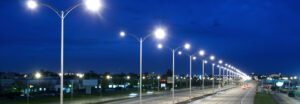
3. Street and Road LED Lighting
Municipal projects across the UAE are replacing traditional sodium vapor and metal halide street lights with LED alternatives. These systems provide better light distribution, adjustable brightness, and compatibility with smart city infrastructure.
4. Solar LED Lighting for Outdoor Projects
Solar LED lighting is increasingly used in Dubai and Abu Dhabi for parks, roads, and remote areas. A typical system includes a solar panel, LiFePO4 battery, charge controller, and LED fixture integrated into a single unit. Abu Dhabi’s strong solar exposure allows reliable nighttime operation.
5. Smart LED Lighting and IoT Integration
Smart LED systems connect with building management platforms using occupancy sensors, daylight sensors, and remote monitoring. Lights operate only when needed and adjust automatically based on natural light, helping large facilities reduce energy consumption by up to 50%.
How to Choose the Right LED Lights in Abu Dhabi
Before selecting LED solutions aligned with current lighting trends in Dubai, it is important to understand a few key specifications. Knowing factors like lumens, efficacy, color temperature, CRI, and IP rating ensures you choose fixtures that deliver the right brightness, energy efficiency, color quality, and durability for your project.
1. Lumens (lm)
measure the actual brightness of the light. Higher lumens mean brighter lighting, so LED products should be evaluated based on lumens rather than wattage.
2. Efficacy (lm/W)
indicates energy efficiency, showing how many lumens are produced per watt. High-quality commercial LEDs typically achieve 100–160 lm/W, while products below 80 lm/W are generally less efficient.
3. Color Temperature (Kelvin)
defines the appearance of the light. Warm light ranges from 2700K–3000K, neutral light from 3500K–4000K, and cool daylight-like lighting from 5000K–6500K, depending on the environment and application.
4. Color Rendering Index (CRI)
measures how accurately colors appear under the light. A CRI of 80+ is suitable for most commercial spaces, while CRI 90+ is recommended for retail, healthcare, and hospitality environments.
IP Rating indicates protection against dust and water. For outdoor lighting in the UAE, IP65 or higher is generally recommended.
Certifications and Standards in the UAE Market
| Certification | Purpose | Relevance |
| Emirates Authority for Standardization (ESMA) | UAE product compliance | Mandatory for market entry |
| IEC 60598 | International luminaire safety | Essential for commercial projects |
| ENERGY STAR | Verified energy performance | Supports green building certifications |
| DLC (DesignLights Consortium) | Efficiency and quality | Relevant for commercial/industrial |
| IP65 / IP67 | Ingress protection | Required for outdoor UAE applications |
Always verify that your supplier can provide documentation for the relevant certifications before committing to a large-scale purchase of LED lights Abu Dhabi projects.
Solar LED Lighting: The Ideal Solution for Abu Dhabi’s Infrastructure Projects
1. How Solar LED Street Lighting Work
Solar LED street lights operate as self-contained off-grid systems. Solar panels convert sunlight into electricity during the day and store it in LiFePO4 batteries. At night, the stored energy powers the LED fixture. Modern systems use smart charge controllers and motion sensors to manage energy use efficiently.
2. Solar LED Projects in Abu Dhabi
Abu Dhabi has widely adopted solar LED lighting in parks, nature reserves, pathways, and suburban developments. The emirate’s strong solar exposure allows batteries to charge fully during normal daylight hours, ensuring reliable nighttime lighting.
3. Advantages of Combining Solar and LED Technology
- Zero electricity costs after installation
- No trenching or underground cabling required
- Operates during power outages
- Easy to expand as infrastructure grows
- Environmentally friendly and aligned with UAE sustainability goals
Maintaining Your LED System
Routine Maintenance Schedule
Despite their durability, LED systems require periodic maintenance to sustain optimal performance. In Abu Dhabi’s dusty environment, regular cleaning of fixture lenses and diffusers is particularly important even modest dust accumulation reduces light output measurably.
Recommended maintenance intervals:
- Monthly: Visual inspection for damage, discoloration, or flickering
- Quarterly: Clean fixture lenses and housings; check for loose connections
- Annually: Inspect drivers for signs of heat stress; verify smart control system firmware is current; measure and record lumen output against baseline
Common LED Problems and Solutions
| Problem | Likely Cause | Solution |
| Flickering | Incompatible dimmer or failing driver | Replace driver; verify dimmer compatibility |
| Premature dimming | Thermal degradation | Improve ventilation; check heat sink |
| Complete failure | Driver failure or connection fault | Replace driver; inspect wiring |
| Color shift over time | Low-quality chips | Specify higher-grade products |
| Buzzing sound | Driver-dimmer incompatibility | Use compatible control gear |
Where to Find Trusted LED Lighting Solutions in the UAE
When it comes to sourcing quality LED lights Abu Dhabi and across the UAE, working with a trusted and experienced lighting partner makes all the difference. The leading lighting design company in the UAE has been transforming residential and commercial spaces since 2018 offering a comprehensive range of indoor and outdoor LED solutions including spotlights, downlights, track lights, and chandeliers.
From private villas and hotel interiors to restaurants, coffee shops, and façade lighting, their team of dedicated lighting designers delivers customized plans tailored to each space’s functional and aesthetic requirements.
With a proven track record across the UAE and a showroom based in Dubai, they remain one of the most reliable names for anyone seeking professional lighting consultation and premium LED products in the region.
LED Lights Abu Dhabi A Smart Investment for the Long Term
The shift to LED lights in Abu Dhabi is now a practical standard across residential, commercial, and public infrastructure due to strong economic and environmental benefits. The region’s hot climate, high energy demand, and sustainability goals make LED lighting a highly efficient solution.
Projects increasingly adopt smart LED systems and solar LED lighting for both urban and off-grid applications.
With proven technology, supportive regulations, and clear cost savings, investing in quality LED lighting solutions in Abu Dhabi remains one of the most effective infrastructure upgrades available today.
FAQs About LED Lights in Abu Dhabi
Here are the most common questions and answers to help you choose, install, and maintain LED lighting efficiently across Abu Dhabi’s residential, commercial, and public projects.
What is the best type of LED lighting for Abu Dhabi’s hot climate?
Which LED fixtures perform best in extreme heat conditions in the UAE?
Choose LED fixtures with aluminum heat sinks, IP65+ protection, and drivers rated above 50°C to ensure stable performance in high temperatures.
How much does it cost to install LED lighting in a commercial building in Abu Dhabi?
What is the typical investment required for a commercial LED upgrade in the UAE?
Costs depend on project size, but most commercial LED upgrades achieve ROI within 18–36 months through energy and maintenance savings.
Are LED lights suitable for outdoor use in the UAE environment?
Can LED fixtures withstand dust and heat in Abu Dhabi’s outdoor conditions?
Yes. LED fixtures with IP65 or higher are protected against dust and water, making them reliable for outdoor use in the UAE.
What is the difference between 3000K, 4000K, and 6000K LED in UAE applications?
How does color temperature affect LED lighting choice for UAE projects?
3000K: residential and hospitality.
4000K: offices and retail.
6000K: warehouses, security, and industrial lighting.
Do I need a permit to install LED lighting in Abu Dhabi?
What regulatory approvals are required for LED installation projects in the UAE?
Large commercial installations must follow ADDC regulations and may require municipal approval through a licensed contractor.
How long do LED lights last in Abu Dhabi’s summer temperatures?
Does extreme heat in the UAE reduce LED lifespan significantly?
Quality LED fixtures typically last 40,000–50,000 hours if proper heat management and ventilation are maintained.
What are the best LED options for street and road lighting in Abu Dhabi?
Which LED street light specifications are recommended for UAE municipal projects?
Recommended specifications include 120–150 lm/W efficacy, IP66 rating, and smart dimming features.
How do I calculate energy savings after switching to LED in the UAE?
What formula should I use to estimate LED ROI for a UAE facility?
Savings = (Wattage reduction × daily hours × 365 ÷ 1000) × electricity rate (AED/kWh).
Are solar LED lights a viable option for government infrastructure projects in Abu Dhabi?
How suitable is solar LED technology for large-scale public projects in the UAE?
Yes. Abu Dhabi’s high solar exposure makes solar LED systems reliable and cost-effective for parks, pathways, and remote areas.
What quality standards should I look for when sourcing LED lights in the UAE market?
Which certifications confirm that LED products meet UAE market requirements?
Look for ESMA compliance, IEC 60598 certification, CRI 80+, and the appropriate IP rating for the application.