


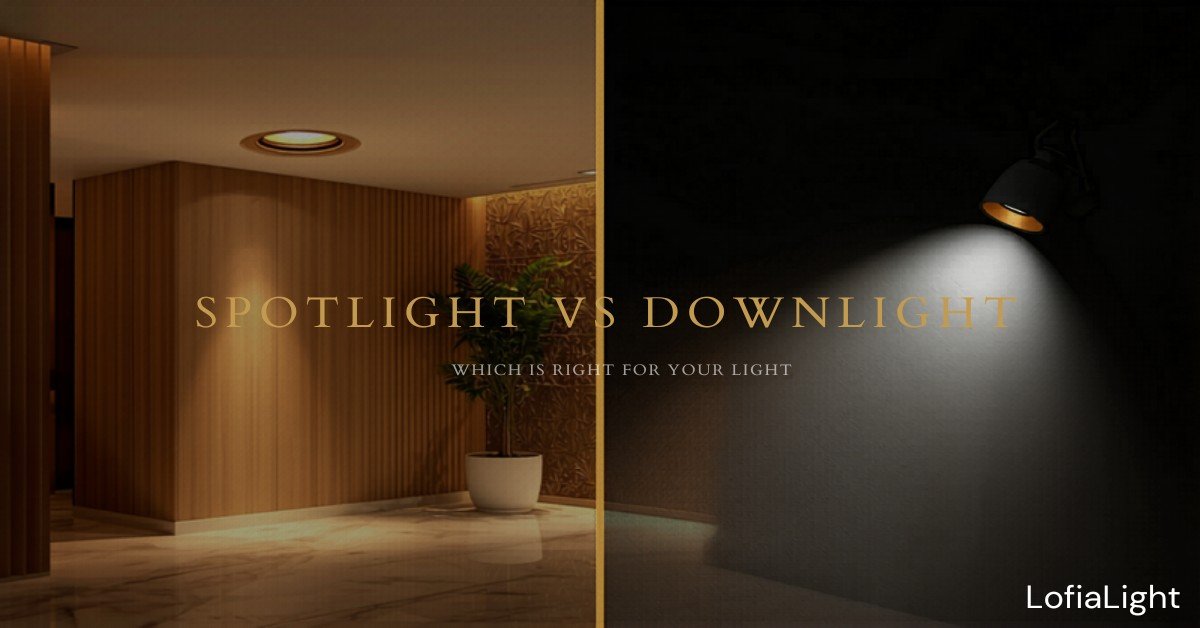
Walk into any lighting showroom in Dubai and you’ll hear the same question from villa owners, interior designers, and developers alike: should I use spotlights or downlights?
It seems like a simple choice. In practice, it’s one of the most important decisions you’ll make for how a space feels — and one of the most commonly misunderstood.
At Lofia Light, we specify both spotlights and downlights across hundreds of projects every year. The right answer almost always depends on the room, the ceiling height, and what you’re trying to achieve. In this guide, we’ll explain the difference, show you exactly where each type excels, and tell you when — and how — to use both together.
What Is a Downlight?
A downlight is a recessed ceiling fixture that sits flush with the ceiling surface and directs light straight downward. When installed, only the trim ring is visible — the body of the fitting sits entirely within the ceiling void.
Downlights produce a cone of light directly below them. This cone has a fixed angle — typically 30 to 60 degrees — and cannot be redirected once installed. The light always points straight down.
Common uses: General ambient lighting across living rooms, hallways, kitchens, and bedrooms. They’re the most widely specified ceiling light in Dubai villa construction.
Typical specifications:
- GU10 or MR16 lamp base
- Beam angle: 36–60 degrees (wide beam = more spread, lower intensity)
- Output: 5–15W LED, typically 500–1000 lumens
- Available in fixed and fire-rated versions
- IP-rated versions available for bathrooms and outdoor soffits
What Is a Spotlight?
A spotlight is an adjustable directional fixture — either recessed into the ceiling or surface-mounted on a track — that can be aimed at a specific point in the room. Unlike a downlight, a spotlight can be tilted and rotated after installation to direct light exactly where you want it.
Spotlights produce a narrower, more focused beam than most downlights. They are designed to light specific objects, surfaces, or zones rather than a general area.
Common uses: Accent lighting on artwork, feature walls, architectural details, retail displays, and kitchen worktops. Also used in galleries, restaurants, and hotel lobbies where directional precision matters.
Typical specifications:
- GU10 or MR16 lamp base (same as downlights)
- Beam angle: 10–36 degrees (narrow beam = more focused, higher intensity at the point)
- Output: 5–15W LED, typically 400–800 lumens
- Adjustable tilt: typically 30–40 degrees from vertical
- Available in single, double, and triple configurations
Key Differences at a Glance
| Feature | Downlight | Spotlight |
|---|---|---|
| Direction | Fixed — always straight down | Adjustable — tilts and rotates |
| Beam angle | Wide (36–60°) | Narrow (10–36°) |
| Primary purpose | Ambient / general lighting | Accent / directional lighting |
| Best for | Filling a room with even light | Highlighting specific features |
| Ceiling appearance | Completely flush | Slightly proud or flush depending on type |
| Flexibility after install | None — position is fixed | High — can be redirected |
| Typical cost | Lower | Higher |
When to Use Downlights
Downlights are the right choice when your primary goal is to provide even, general illumination across a space. They work best when:
You Need Consistent Ambient Light
A grid of downlights across a living room, kitchen, or hallway provides a baseline level of light that covers the whole floor area. This is their strongest use — filling a space uniformly without creating bright spots or dark patches.
The Ceiling Is Clean and Uninterrupted
Downlights sit flush with the ceiling, making them ideal when you want to keep the ceiling surface visually clean. In minimalist Dubai interiors — particularly contemporary villas with smooth plaster ceilings — downlights maintain the architectural purity of the space.
You’re Lighting Functional Areas
Kitchens, bathrooms, utility rooms, and corridors benefit from the consistent downward light that downlights provide. These are task-oriented spaces where broad coverage matters more than drama.
Budget Is a Consideration
Downlights are typically less expensive per unit than adjustable spotlights and faster to install. For large floor areas requiring many fixtures, the cost difference is significant.
Where downlights fall short: They cannot light vertical surfaces — walls, artwork, or architectural features. A room lit only with downlights will have a brightly lit floor and dark walls, which creates a flat, uninspiring atmosphere regardless of how premium the fittings are.
When to Use Spotlights
Spotlights are the right choice when you want to direct attention to something specific — a feature, an object, or a zone within a room. They work best when:
You’re Lighting Artwork or Display Objects
A spotlight aimed at a framed piece of art or a sculptural object creates exactly the kind of gallery-quality accent lighting that makes a space feel curated and intentional. The narrow beam concentrates light on the object and creates contrast against the surrounding wall — the same technique used in every high-end hotel lobby and restaurant in Dubai.
You’re Highlighting Architectural Features
Feature walls, textured stone, decorative niches, columns, and archways all benefit from directional lighting. A spotlight angled at a textured wall creates shadow and depth that makes the material come alive. The same wall lit with a downlight from above will look flat.
The Layout May Change
Because spotlights are adjustable after installation, they’re ideal for spaces where furniture or display arrangements might change over time. A track-mounted spotlight system in a living room can be redirected whenever you rearrange. A grid of fixed downlights cannot.
You’re Designing a Commercial or Hospitality Space
Restaurants, cafés, retail spaces, and hotel lobbies in Dubai almost universally use spotlights as their primary accent lighting. The ability to direct light precisely onto tables, product displays, or feature elements is essential in these environments — and the focused beam creates the atmosphere that makes guests want to stay.
Where spotlights fall short: They don’t provide even ambient coverage. A room lit only with spotlights will have bright focal points and dark areas between them. They work as an accent layer, not a primary ambient source.
Room-by-Room Guide: Downlight, Spotlight, or Both?
The best lighting schemes almost always use both — downlights for ambient coverage and spotlights for accent and drama. Here’s how that works room by room.
Living Room
Downlights: Use a perimeter ring of downlights (or cove lighting) to provide soft ambient light around the edges of the room. Avoid a central grid — it creates a flat, commercial feel.
Spotlights: Use adjustable spotlights to accent the feature wall, any artwork, and the main focal point of the room — a fireplace surround, a display unit, or a decorative object.
Result: The downlights create a warm base; the spotlights create focal points and visual depth. The room feels alive, not just lit.
Kitchen
Downlights: A grid of downlights provides general kitchen illumination. Position them to fall over worktop areas for task lighting. In open-plan layouts, the kitchen zone should be slightly brighter than adjacent living areas.
Spotlights: Use adjustable spotlights above the island or peninsula to create a focused zone of activity. Under-cabinet LED strips serve a similar directional purpose for worktop task lighting.
Result: Functional coverage from downlights, with spotlights marking the island as the social and visual centrepiece of the kitchen.
Master Bedroom
Downlights: Use sparingly or not at all as the primary source. A central downlight in the bedroom ceiling is one of the most common villa lighting mistakes in Dubai — it shines directly into your eyes when you’re in bed. If used, keep downlights on a separate dimmer and close to the perimeter.
Spotlights: Use adjustable spotlights to light the headboard wall, any artwork, and wardrobe areas. Cove lighting is often the best ambient choice in bedrooms — but where ceiling recessing is limited, perimeter downlights with spotlights for accent achieve a similar layered effect.
Result: A layered bedroom scheme that can shift from functional to atmospheric with a dimmer.
Bathroom
Downlights: IP-rated downlights provide general bathroom illumination. Essential over the shower area (IP65 minimum) and throughout the ceiling.
Spotlights: An adjustable spotlight aimed at the vanity or mirror provides directional task light. Some bathroom designs use small spotlights to accent freestanding baths or decorative wall tiles.
Result: Downlights handle the functional brief; spotlights elevate the bathroom from functional to spa-like.
Majles
Downlights: Use very carefully in a majles. If used at all, keep them on a low dimmer as a background layer only. Standard downlights positioned above seating will create overhead glare — the opposite of the warm, intimate atmosphere a majles requires.
Spotlights: Adjustable spotlights are ideal for highlighting the decorative ceiling, niches, archways, and key architectural features of the majles. Aim them at the architecture, not the seating.
Result: Architectural accent from spotlights, with cove lighting or wall sconces providing the warm ambient base.
A Common Mistake: Using Only Downlights Throughout
The single most common lighting mistake we see in Dubai villas is specifying nothing but downlights from room to room. It’s the default option in many contractor specifications — it’s cheap, it’s fast to install, and it technically provides light.
But it produces spaces that look flat, feel corporate, and fail to make the most of the architecture and finishes that the villa’s owner has invested in. Expensive marble, luxury furniture, and premium joinery all need light hitting them at an angle to show their texture and depth. Downlights — pointing straight down — don’t do this.
The fix is not complicated or expensive: adding a layer of adjustable spotlights to highlight the key features of each room transforms the space. It doesn’t require rewiring — spotlights can often be added to an existing downlight circuit or a new dedicated accent circuit.
Lofia Light Projects: Spotlights and Downlights in Practice
- Private Villa — Jumeirah Golf Estates: A full villa redesign where the original specification was entirely downlights throughout. We kept the existing downlight positions for ambient coverage and added a layer of adjustable GU10 spotlights on separate circuits in the living room, dining room, and master bedroom. The homeowner described the before-and-after as “like a completely different house.”
- Restaurant — Dubai Marina: A hospitality project where the brief was drama and intimacy. We used no general downlights at all — every ceiling fitting was an adjustable spotlight, directed at tables, bar surfaces, artwork, and the feature back wall. The downward ambient light came entirely from table lamps and perimeter wall sconces.
- Showroom — Business Bay: A commercial lighting design using track-mounted spotlights throughout, allowing the client to redirect all accent lighting as product displays changed. Downlights were used only in the service areas and fitting rooms where consistent functional light was the priority.
How to Choose: A Simple Framework
When deciding between spotlights and downlights for a specific space, ask three questions:
- What are the key features I want to highlight? — If there are architectural details, artwork, or focal points worth emphasising, spotlights are needed. If the space is entirely functional with no features to accent, downlights alone may be sufficient.
- What atmosphere do I want in the evening? — Spaces designed for relaxation, entertaining, or hospitality need layered lighting with accent capability. Spotlights are essential. Functional spaces — corridors, utility rooms, garages — can be fine with downlights only.
- Is this a permanent installation or might it change? — If the space is likely to evolve (furniture rearranged, art rotated, displays updated), the adjustability of spotlights is a long-term advantage worth the additional cost.
For most rooms in a Dubai villa, the answer is: use both. Downlights for the ambient base, spotlights for the accent layer. This is the approach taken in every well-designed luxury interior in the UAE — and it’s the default specification at Lofia Light.
For a full lighting consultation — where we assess your space, identify what needs accenting, and recommend the right combination — visit our villa lighting design page or explore our room-by-room villa lighting guide.
Frequently Asked Questions
Can I replace my existing downlights with spotlights?
In most cases, yes. Many adjustable spotlight fittings use the same GU10 lamp and cut-out size as standard downlights, making a like-for-like swap straightforward. The key requirement is enough ceiling void depth to accommodate the spotlight body — typically 60–80mm. Our team can assess this during a site visit.
What beam angle should I choose for spotlights?
For lighting artwork or a specific decorative object: 15–25 degrees (narrow beam, concentrated light). For lighting a larger feature wall or architectural element: 25–36 degrees (medium beam, more spread). For general accent lighting across a zone: 36+ degrees (wide beam, closer to a downlight effect).
Are spotlights more expensive than downlights?
Generally yes — adjustable spotlights cost more per unit than standard fixed downlights. However, the difference is often smaller than people expect, and the visual improvement more than justifies the additional cost. In a premium Dubai villa, the lighting budget is typically 3–5% of the total fit-out cost.
How many spotlights do I need per room?
This depends entirely on how many features you’re accenting and how large the room is. As a general guide, a typical Dubai villa living room might have 4–8 downlights for ambient coverage and 4–6 spotlights for accent. The key is quality of placement, not quantity.
Do spotlights and downlights need to be on separate circuits?
They don’t have to be, but it’s strongly recommended. Putting them on separate circuits (ideally with separate dimmers) gives you full scene control — you can have ambient downlights at 30% and accent spotlights at 80%, or vice versa. This flexibility makes an enormous difference to how versatile the room feels in use.
Can spotlights be used outdoors?
Yes — IP65-rated adjustable spotlights are available for outdoor use and are commonly used in Dubai villa facades and garden uplighting. They need to be rated for the UAE climate (heat-resistant drivers, dust protection). See our landscape lighting guide for outdoor-specific recommendations.
Get the Right Combination for Your Space
Whether you’re specifying lighting for a new villa, redesigning an existing space, or simply adding an accent layer to a room that currently only has downlights — getting the spotlight and downlight combination right makes a significant difference to how your home looks and feels.
Lofia Light designs lighting schemes for Dubai villas and commercial spaces across the UAE. We specify the right fixture, the right beam angle, and the right circuit configuration for every room — so you get a space that performs as well as it looks.
Book a free lighting consultation — our designer visits your property, assesses the space, and recommends the right combination of spotlights and downlights for every room.